Showing posts with label musings. Show all posts

Monday, August 30, 2010

The EPA and you.

Some of you may have read about the EPA's proposed new ratings system for automobile fuel efficiency and emissions:


Well, I decided that I'd add to things by coming up with my own ratings system that consumers would more easily be able to relate to the environment, as opposed to misinterpreting the EPA's letter grade as a judgment of the car as a whole. Then again, any car that'll save you -$6900 over the course of five years and is likened to an atom bomb detonating by the EPA must be a really awesome ride. Let me know what you think ;-p


(click to enlarge)


Friday, August 27, 2010

Perfectly normal thought process...

What's the first thing you think of when you're jarred awake by a sudden, deafening thunderclap shortly followed by rain, the noise from which can only be described as a roar, in the middle of a summer afternoon... and you notice that the air conditioner is running?

Well, if you answered "Hmm, if it's still 103°F outside, then the increase in humidity that'll result from this rain will even further reduce the efficiency of our central air conditioning system," then you and I are a lot alike because this is exactly what occurred about two days ago. What's particularly fascinating to me, in retrospect, is the chain of thoughts which resulted from this very simple starting point. They went something like this:

"I wonder if the evaporative cooling effect caused by rainwater being sucked through the condenser would offset the efficiency loss caused by increased ambient humidity? How much of an overall efficiency gain could be had by setting up a simple condenser sprayer/mister system? What about building a water jacket for the condenser or putting together a refrigerant-to-water heat exchanger and plumbing it to a large evaporative cooler (Engineering folks: think a small cooling tower. Computer water cooling folks: think a really big bong cooler)? Taking the evaporative cooler approach, you'd be able to improve heat transfer by attaining a larger temperature delta between the condenser and the fluid cooling it than would otherwise be possible with direct-to-air cooling."

To complete what ended up turning into a mini engineering thought exercise I, of course, had to also go through some of the disadvantages associated with such experimentation which boiled down to:

- Cost to construct a sufficient evaporative cooling system vs. possible electricity savings from improved system efficiency (experimentation would have to start with a mister system and small scale condenser immersion testing with a cheap wall-mount air conditioning unit to determine project feasibility).
- Increase in household water usage during the months the evaporative cooling system is in use.
- Increased cooling system complexity (and a corresponding drop in likely reliability).
- Increased cooling system maintenance (lines and fittings would need to be checked for leaks, circulation pump intake filter(s) would require cleaning, the cooling system would have to be manually topped-up regularly (if an automatic coolant reservoir refill system isn't constructed), fan intake filters (if used) would require cleaning, coolant would have to be treated to mitigate biological growth, mineral deposits, and possible corrosion (if incompatible metals are used in the absence of a sacrificial anode), etc.).

I realize that, to most, this entire idea would probably come off as being rather ridiculous but, regardless of the merits of the original idea, it's the process that's important here. I constantly launch into this sort of thinking and it can be sparked by practically anything... after all, how else are we supposed to keep our minds sharp?

Monday, June 28, 2010

Four cores on the cheap... all while consuming less than 100W

A couple of months ago, the guys in the XtremeSystems World Community Grid forum reminded me of how wonderfully inexpensive old Intel server hardware has become... so, without further ado, I bring you a $200 quad-core system (just add a hard drive, E-ATX compatible case [optional], and video card [optional]).

Way back in 2006, the tech industry was clamoring for a cool and efficient alternative to Intel's lineup of 95W+ TDP NetBurst-based Xeon processors. Intel, having just released single and dual-core Yonah variants (based on the Dothan Pentium M CPUs) for the desktop/mobile market, responded by adapting the dual-core Yonah for multi-socket applications and adding support for 36-bit memory addressing. Thus, the 31W (Xeon LV) and 15W (Xeon ULV) dual-core Sossaman was born. The tidbit that I find most interesting about the Sossaman/Yonah/Dothan CPUs is that they're, essentially, an evolution of the old Pentium Pro's P6 microarchitecture. Anyway, getting back on track, the Sossaman and Yonah CPUs turned out to be very, very short-lived products for Intel, as they were used as stepping stones to reach what we now know as the Intel Core microarchitecture. The greatest shortcoming of the Sossaman/Yonah CPUs is their lack of x86-64 support and it was this key shortcoming which contributed to their short, dead-end lifecycle.

So, what does all of this mean to enthusiasts? Well, since the Sossaman is a 32-bit only dead-end product (there is no upgrade path), it's not something which the IT industry has a demand for. What happens to old computer tech that is no longer in demand (come on, everyone should know this one by now)? It becomes dirt cheap!

Here are the basics that you'll need:

- (2x) Intel Xeon LV SL8WT (2.0GHz Dual-Core Sossaman): here (note: this eBay auction has ended, it's provided as an example of about what you should be paying per chip [$25-$35])

- (1x) Intel SE7520BB2 dual-socket Baker Bay server motherboard: here ($9.99)

- 2GB-4GB 1Rx4 PC2-3200 ECC registered memory: here ($20-$60)

- (2x) CPU heatsinks [$10 ea.] (This is something you'll have to improvise unless OEM XS gets more of the Intel "ABB" 'sinks back in stock [Intel p/n: ABBHEATSINKS] or you can find them elsewhere. Keep in mind that the Intel "ABB" style heatsink has a 3mm step in the base to allow for proper contact with bare-die CPUs)

- (1x) Xeon backplate: here [$2.95] (only needed if you're either running the system caseless or you're using a case which does not have standoff locations for Xeon heatsink mounting)

- (1x) Quality power supply [$50] (doesn't need to be rated for more than 350-450W... but it needs to be a quality unit with a 24-pin ATX connector and an 8-pin EPS-12V connector): something like this, this, or this would be fine

Simply add a spare HDD and you're good to go since the motherboard is equipped with onboard video (VGA). Granted, the onboard GPU is an old ATI Rage XL... so don't expect much from it. The board does have a PCI-e v1.x 8x slot, though, which can be modified to accommodate a PCI-e 16x video card--all you have to do is carefully hack off a portion of the motherboard's PCI-e 8x connector. Now, since it's only a v1.x 8x slot, throughput will be limited and this is something which will be noticeable with cards much faster than an HD4850 or GTX260 (throughput is so limited, in fact, that overclocking said cards results in almost no appreciable performance gain in 3DMark). The above system should be able to score about 9600 points in 3DMark '06 when running with an HD4850. If you're one of those folks who enjoys having their computer make sounds, then you'll have to invest in a used sound card (I managed to score an Audigy 2 ZS from an XS forum member for $30) or pick up a random cheap one.

It's about now that I should probably mention that the hardest part of this build is tracking down those Xeon SL8WT processors at a reasonable price. There may not be a significant industry demand for these parts anymore, but there's no shortage of scalpers on eBay hoping to gouge some poor IT guy in need of a replacement part. They do pop up in bulk at sane prices from time to time, but you'll have to be patient and vigilant.
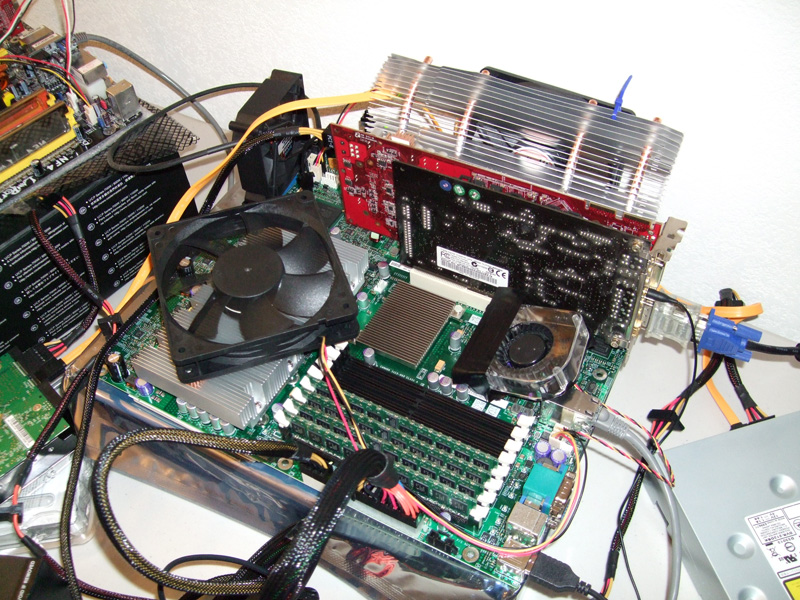

There's SammyOne during its caseless testing phase. In case you're wondering about the name, yes, I have two of these things now (one on Vista, one on Ubuntu) and have even replaced my gaming rig with SammyOne (Phobos will be hitting Craigslist shortly). Using World Community Grid output as a benchmark, this Sossaman system isn't that much less powerful than Phobos' E8400 running at 3.6GHz (~10,213 WCG PPD vs. ~9,000 WCG PPD), it uses substantially less power, produces far less heat, and has been handling daily use multitasking quite well (maybe even a bit better than Phobos when BOINC is running).

I'll update this post tomorrow with a photo of SammyOne in its long-term home: a Stacker 832. Eventually, I hope to cram both SammyOne and SammyTwo into the same Stacker 832 case through modifying the hinged fan carrier to accommodate a ghetto-fab acrylic E-ATX motherboard tray.

Update: Here are those photos I promised (TwitPic thumbnails, click to view the whole photo).

SammyOne resting comfortably within a Stacker 832 on Twitpic A close-up shot of SammyOne in its current home... on Twitpic

Saturday, October 3, 2009

[PT Archive '08]: Yahtzee Talks Water Cooling... well, not really.

This week's episode of Zero Punctuation is a little different than usual and touches upon a phenomena which goes far beyond the realm of computer games...


First thing's first... watch the video:


So, did you catch it?  Here's a tip: it has to do with the letter from Cpt. James Obvious.

Okay, time's up... I'm not going to sit here waiting for everyone to figure it out.  In this video, Yahtzee touches upon people's desire/need for some sort of authoritative approval of something (be it a video game, waterblock, bookend, or toilet seat) before being able to justify its purchase or, in some instances, its existence.  In addition, he mentions people's issues with "reviews" that don't boil all of their content down into some meaningless numerical value that can be directly compared to anything and everything else.  See where I'm going with this yet?

Now, I'd probably be better equipped to express all of this if it weren't so late, but I'll give it a go anyway...  It is the job, nay, the duty of a hardware reviewer to be a critic, to find a product's faults, and to carefully balance their criticism with mentionings of a product's more positive aspects (if any exist).  Tragically, it's this balance that's missing from most tech sites (and "reviewers") these days, as most seem to have turned to little more than shills for product manufacturers in an effort to ensure an uninterrupted stream of junk for them to beam over... all the while, racking up clicks and impressions for their paying advertisers.  Personally, I tend to err on the side of overly criticizing a product or product manufacturer, as opposed to making everything out to be the best thing since sliced bread--I suppose that I'm just strange.  Anyway, getting back on track, I've been seeing more and more of people shunning credible, comprehensive analysis of a given product in favor of half-baked, utterly useless reviews blathering on about how great something is.  The reason: because they're simpler.  If a person doesn't understand the information and commentary that's being presented, they tune out and go look for some black & white "review" written by another half-wit that just tells them what to buy regardless of whether or not it's really the best option for the individual.  If you ask me, I'd expect people to go out and LEARN the basic information required to understand the better review--sounds reasonable enough, doesn't it?  After all, things like computer cooling really aren't complicated... and if you understand the basics, then you can actually make educated decisions about what is best for you *gasp*!  Though, with the sheer volume of misinformation floating around in forums and such, I can't help but wonder if I'm expecting too much (a truly disheartening thought).  Has the passion for knowledge and understanding died in so many?